
Knowing how to tell if gold is real starts with the stamp and ends with a scale. A hallmark such as 585 or 750 tells you what the metal is meant to be, a handful of checks you can do at the kitchen table tell you whether the piece behaves like solid gold, and a jeweler with the right instrument can settle the question in under a minute without leaving a mark. Most fakes fail long before the instrument is needed. The order matters: read the stamp, weigh the piece against its size, look at the places that wear, and only then reach for a magnet or a test kit. Each check rules something out, and none of them on its own proves anything.
Start With the Stamp: What 585, 750 and 14K Mean
Real gold jewelry is stamped with its purity, and learning to read that stamp answers most of the question. The mark is either a karat number or a three-digit fineness figure, and the two say the same thing in different units. Karat counts parts out of twenty-four; fineness counts parts out of a thousand. So 14K gold is 585 fine, which is 58.5 percent gold by weight, and the two stamps are interchangeable. 18K gold is stamped 750, meaning three-quarters gold by weight, and a 750 gold stamp on a ring or clasp is simply the European way of writing 18K. Lower down the scale, 10K is stamped 417, and at the top 22K is 916 and 24K is 999.
The stamp is usually small and sits somewhere the eye does not fall on first: the inside of a ring shank, the back of a pendant, a small tag near the clasp of a chain, or the clasp itself. A loupe helps, and so does raking light from a lamp held low. Some marks also carry a maker's or assay symbol beside the number, which is a good sign, because a counterfeiter tends to copy the number and skip the rest.
Some stamps are there to tell you the piece is not solid gold, and these are worth memorizing. GP, GEP and HGE mean gold-plated or gold electroplated, a thin layer over base metal. RGP means rolled gold plate. GF, often written as a fraction such as 1/20 14K GF, means gold-filled, a thicker bonded layer that is still a layer. Vermeil is gold over sterling silver, and a piece marked 925 with a gold surface is vermeil by definition. Any of these marks settles the matter: the surface is gold, the piece is not.
A stamp can be faked, and on a counterfeit it usually is, because a 585 is cheap to strike into brass. That is why the stamp is the first check and not the last. It tells you what the piece claims to be. The checks that follow tell you whether the claim holds.
How Do You Test Gold at Home? Six Checks in Order of Reliability
None of the tests below needs a kit, and none of them damages the piece. Do them in this order, because each one is more informative than the last and each one takes a little longer.
Weight against size. Gold is heavy, far heavier than brass, steel or silver, and the difference is large enough to feel. A solid gold chain of a given width and length weighs several times what a plated brass chain of the same pattern weighs, and a solid ring feels dense in the palm in a way a costume ring does not. If you have a kitchen scale that reads to a tenth of a gram, weigh the piece and compare against a listing for a solid piece of the same pattern and size. A large chain that weighs very little is either hollow or not gold.
The wear points. Plating wears through where the piece rubs: the inside of a ring shank, the underside of a bracelet, the edges of links, the back of a pendant where it sits on a shirt. Look at those places under a bright lamp. A darker or pinker metal showing through gold is base metal, and the piece is plated. Solid gold wears too, but it wears to more gold, so the color is the same all the way down.
Discoloration on the piece. Solid gold alloys can dull slightly with time, because the silver and copper in the alloy react with the air, and a dulled chain is not evidence of a fake. What solid gold does not do is turn green, flake, or show a different metal at a scratch. If the piece has gone green or black in patches, or the surface has lifted, it is plated.
Marks on the skin. A green or gray mark on the finger is the check people trust most and it is the least reliable. Copper is what leaves the mark, and 14K gold contains copper, so a solid 14K ring can mark some skin on a hot day while a plated ring on another hand leaves nothing. Treat a skin mark as a prompt to look harder, not as a verdict. Our article on why gold jewelry turns skin green explains what is actually happening.
The magnet. Gold is not magnetic, and neither are the copper, silver and zinc it is alloyed with. A strong magnet, the kind sold for hobby use rather than a fridge magnet, will not pull on solid gold at all. It will pull on steel and on many plated base metals. The trap is the clasp: lobster and spring-ring clasps often contain a small steel spring, so a magnet that grabs the clasp and nothing else has told you about the spring. A magnet that grabs the links has told you about the chain.
The float. Drop the piece into a glass of water. Gold sinks fast and straight. A piece that drifts, hesitates or floats is light for its size, which points to a hollow or non-gold construction. This is the weakest test on the list because most base metals sink too, but it catches the worst fakes and costs nothing.
Two folk tests are best skipped. Rubbing the piece on unglazed ceramic to look for a gold streak leaves a scratch on a piece that turns out to be real. Vinegar and bleach do nothing useful to gold and can mark the alloy or damage a stone. Neither tells you more than the six checks above.
How to Tell if a Gold Chain Is Real
Chains are the piece most often faked, because a chain is bought by the look and a plated brass chain photographs exactly like a solid gold one. The checks are the same as above, but a chain gives you a few extra places to look.
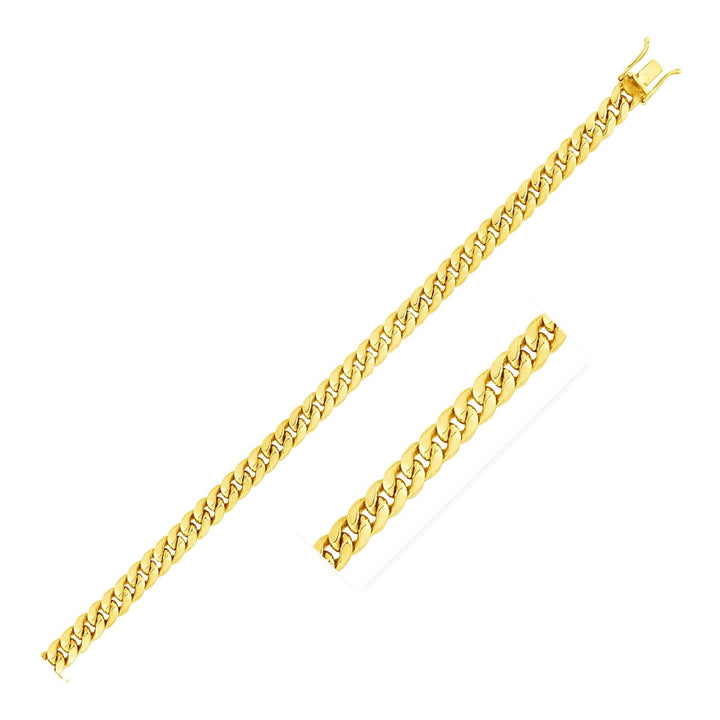
Find the stamp first. On most chains it sits on a small oval tag beside the clasp, or on the clasp itself. On a DEEVE bracelet the hallmark is on the clasp. Read the number, then check that the clasp and the tag are the same color as the links. A counterfeit chain is sometimes built from a stamped solid clasp joined to plated links, so a stamp on the clasp proves the clasp.
Then weigh the chain against its length. A listing for a solid chain should give the gram weight, and the weight should rise in proportion to the length. The 6.00 mm Figaro bracelet compared below weighs 7.9 grams at the shorter length and 9.5 grams at the longer, and that proportion is what solid stock looks like. A chain that is wide in the photograph and light on the scale is hollow at best. Our article on hollow vs solid gold chains goes through the weight question in detail, because hollow and plated are two different things and both show up as low weight.
Finally, look at the links where they rub each other. A chain moves constantly, and the contact points between links are the first place plating fails. On a chain that has been worn for a season, a plated one will show a darker metal at the inside of the links while the outer faces still look gold. Solid gold shows nothing but gold at any angle.
How to Tell if Jewelry Is Real Gold With No Stamp
Older pieces, resized rings and jewelry made outside the systems that require a mark can be solid gold with no stamp at all, and a worn stamp on a thin shank is common. The absence of a mark is not the absence of gold. What changes is that the home checks now carry the whole weight of the question, and they were never designed to.
Weight is the best of them. If the piece is heavy for its size, has the same color at the wear points, and does not respond to a magnet, it is very likely gold, and the remaining question is which karat, which no home test can answer. Color is a poor guide to purity because alloying decides it: an 18K piece and a 14K piece can be made to look identical, and a rose gold piece is the same purity as a yellow one with more copper in the recipe.
At that point the honest next step is a jeweler. The tests a bench uses are quick, most of them are non-destructive, and they answer both questions at once: whether the metal is gold, and how much gold is in it.
Expert Breakdown: What the Professional Tests Actually Measure
A jeweler has four tools for this, and it helps to know what each one is measuring so the result means something.
XRF analysis is the one to ask for. An X-ray fluorescence analyzer reads the elements present at the surface of the metal and reports them by proportion in a few seconds, without touching the piece. It names the gold content directly, and it names the alloying metals with it, which is how a bench can tell a nickel white gold from a palladium one. Its limit is depth: XRF reads the surface, so a thick plating can read as gold. A careful operator tests at a wear point or a filed edge as well as the face.
The acid test is the traditional method and the one sold as a home kit. The piece is rubbed on a touchstone to leave a streak of metal, and acids of increasing strength are applied to the streak. A streak that survives the 14K acid and dissolves under the 18K acid is 14K. It is accurate in practiced hands and it is destructive in the small sense: the piece is scratched to make the streak, and the acids are hazardous. It is a bench test, not a kitchen one.
Electronic testers measure electrical conductivity through a probe and a gel, and infer karat from it. They are fast and non-destructive, and they are also easily fooled by plating and by unusual alloys. A bench uses them for a first pass, not for a verdict.
Specific gravity is the oldest test and the one that cannot be faked by a surface. The piece is weighed in air and then weighed suspended in water, and the ratio gives its density. Gold is denser than every metal it is commonly faked with, and each karat has its own density band. The test fails only on hollow pieces, where trapped air spoils the reading, and on pieces set with stones, which have to be measured around.
The four together leave nothing hidden. XRF names the alloy, specific gravity confirms the piece is that alloy all the way through, and the acid and electronic tests corroborate. A jeweler who uses two of them and reads the stamp has answered the question about as well as it can be answered.
What Honest Documentation Looks Like
The simplest way to avoid testing gold is to buy from a seller who has already done it and says so in writing. The listing should state the karat, the construction and, for a chain or bracelet, the gram weight by length. The piece should arrive hallmarked to match. And the seller should stand behind the purity with a document and a warranty rather than a photograph.
Every DEEVE piece is solid 14K or 18K gold, hallmarked, with the karat stated on the listing, and covered by a lifetime warranty serviced in-house. A certificate of authenticity for the gold purity is issued with each order. That combination is what a real gold piece should have behind it, and a seller who cannot offer all three is asking you to do the testing yourself.
To see the range, start at the gold chains collection or with the solid 14K Figaro chain bracelet whose weights are quoted above. For the wider framework on weight, construction and repairability, read the buying section of our complete gold guide, and for what the stamp means once you have found it, what 14K gold is.



0 comments