

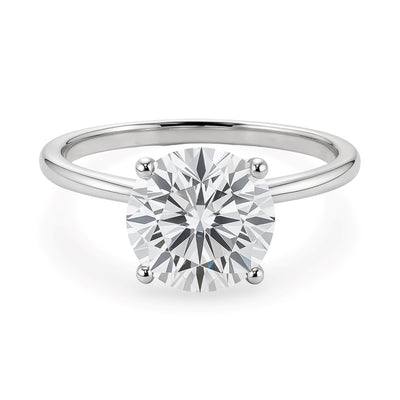
To choose an engagement ring, decide the budget first, then the diamond: lab-grown or natural, then shape, carat weight and grade, then the metal, the setting and the ring size. Lab-grown leads for most couples today because the same budget reaches a larger, higher-graded stone. Every ring in our lab-grown diamond engagement rings collection is a four-prong solitaire in solid 14K white gold, graded G VS1 and sent with its IGI certificate in the box. This guide takes each decision in the order it should be made, and explains what to check before you buy.
Step 1: Set the Budget, Then Choose Lab-Grown or Natural
Decide what you can spend without strain before you look at a single stone. The old rule of three months' salary was an advertising line, not a measure of anything, and there is no correct amount. A number fixed in advance turns every choice after it into a trade-off you control rather than a negotiation you lose.
The first trade-off is also the largest: a lab-grown or a natural diamond. A lab-grown diamond is a real diamond, the same carbon crystal with the same hardness, 10 on the Mohs scale, and the same brilliance. It is grown under controlled conditions instead of mined. Graded on the same scale, the two cannot be told apart by eye. Lab-grown costs approximately 70% less than natural at the same size and grade, so the decision moves your budget further than any other on this list.
| Factor | Lab-grown | Natural |
|---|---|---|
| Composition | Diamond (carbon crystal) | Diamond (carbon crystal) |
| Hardness | 10 (Mohs) | 10 (Mohs) |
| Appearance | Identical at the same grade | Identical at the same grade |
| Cost at the same size and grade | Approximately 70% less | The benchmark |
| Origin | Grown, no mining | Mined |
| Resale value | Lower | Higher |
Choose lab-grown if you want the largest, best-graded stone your budget allows and you are buying a ring to wear every day for decades rather than to resell. Choose natural if resale value or a stone formed over geological time matters more to you than size. DEEVE's natural diamonds are conflict-free and responsibly sourced. For the full comparison, read lab-grown vs natural diamond engagement rings, and for what couples spend, the average engagement ring cost.
Step 2: Choose the Diamond Shape
Shape is the first thing anyone notices, and it is the choice most tied to taste. It also changes how large a stone looks at a given weight and how much of its grade shows. Our lab-grown solitaires come in six shapes:
- Round brilliant. The most light return of any shape and the most classic. Its facet pattern is the most forgiving of color and small inclusions.
- Oval. A brilliant cut drawn into a longer outline. It tends to look larger face-up than a round of the same weight and lengthens the finger.
- Cushion. A square or slightly rectangular outline with rounded corners, softer and more vintage in character.
- Princess. A square brilliant with sharp corners. The prongs sit over those corners, which is where the stone needs protecting.
- Emerald. A step cut: long, open facets that show clarity plainly and flash rather than sparkle. A VS1 grade suits it well.
- Radiant. A rectangle or square with trimmed corners and brilliant faceting, combining the outline of an emerald with the sparkle of a round.

If you cannot decide between two outlines, look at the 2 carat oval and the 2 carat emerald side by side: the same weight reads as two very different rings. The best guide to shape is the jewelry your partner already wears. Someone who wears clean, geometric pieces tends toward emerald or princess; someone who wears softer, rounded pieces tends toward round, oval or cushion.
Step 3: Choose the Carat Weight
Carat is weight, not size, and price rises faster than weight: a 2 carat stone costs well over twice a 1 carat stone of the same grade, because large rough is rarer. That is true of lab-grown and natural diamonds alike, though the curve starts much lower for lab-grown. Our lab-grown solitaires are offered at 1, 1.5, 2, 3 and 5 carats in every shape.
What a weight looks like depends on the shape. For a round brilliant, the trade's standard face-up diameters are approximately:
| Carat weight (round) | Approximate diameter |
|---|---|
| 1 ct | about 6.4 mm |
| 1.5 ct | about 7.4 mm |
| 2 ct | about 8.1 mm |
| 3 ct | about 9.3 mm |
Cut proportions move each figure by a few tenths of a millimeter, and fancy shapes vary with their length-to-width ratio, so treat the table as a guide to scale. Two practical points matter more than the numbers. First, weights just below a round number cost noticeably less and look the same on the hand. Second, finger size changes the effect: the same stone looks larger on a slender finger than on a broad one. A 1 carat round is a refined everyday ring; the 2 carat round is where a solitaire starts to read as a statement from across a room.
Step 4: Read the Grade: Cut, Color and Clarity
With weight chosen, the other three Cs decide how the stone looks. They are not equal, and the order in which you protect them matters.
Cut: never trade it away
Cut is the only grade that is a matter of workmanship rather than nature. It decides how much light enters the stone and returns to the eye. A poorly cut large diamond reads dull and glassy; a well-cut smaller one carries the light across a room. Every DEEVE lab-grown diamond is cut to Excellent, with Excellent polish and symmetry.
Color: G sits in the efficient band
Color is graded from D (colorless) downward. G (near-colorless) faces up white in a white gold setting, and the difference between G and the colorless grades above it is very difficult to see without a grading lamp beside it. Larger stones and step cuts show color more, so a G grade is a sensible floor for the carat weights in this guide.
Clarity: VS1 is clean to the eye
Clarity describes the tiny internal features every diamond forms with. VS1 (very slightly included) means those features are minor and difficult to find even under ten-times magnification; they are not visible to the naked eye. That matters most for an emerald cut, whose open facets hide nothing.
Every ring in our lab-grown engagement collection is graded G (near-colorless) and VS1 (very slightly included), cut to Excellent, so the grade is settled before you choose and the decision comes down to shape and weight. For a deeper look at grading, see our complete guide to lab-grown diamonds.
Step 5: Choose the Metal and the Setting
Choose the metal against how your partner lives, not only against the diamond. Fourteen-karat gold is 58.5% pure gold alloyed with stronger metals, and it is the practical karat for a ring worn every day: harder and more resistant to scratches and bending than higher-purity gold. For the trade-offs between karats, read 14K vs 18K gold.
Our lab-grown solitaires are offered in solid 14K white gold. White gold carries a rhodium finish that makes it bright and cool, a natural partner for a G color diamond. Rhodium is a wear surface and renews over time; on a DEEVE ring, re-plating is covered by the lifetime warranty at no charge.
The setting is architecture before it is decoration. A four-prong solitaire, the setting every ring in this collection uses, holds the stone securely while letting the most light reach it, and it is the easiest setting to clean and to inspect. The band is 1.50 mm wide, a slim profile that keeps the eye on the diamond. If your partner works with their hands, ask how the stone sits relative to the band and plan for an annual prong check, which is part of our service for life. A slim band also leaves room for a wedding band to sit beside it later.
Step 6: Get the Ring Size Right
A ring that fits sits snugly over the knuckle and does not spin. If the proposal is a surprise, you have to find the size without asking. The reliable methods, from best to least reliable:
- Borrow a ring they already wear on the ring finger and have it measured, or trace its inside edge on paper. A ring from another finger is a guess.
- Ask someone close to them who knows their size or can find out without giving the plan away.
- Measure the inside diameter of a ring they wear often against our ring size chart.
Avoid the string-around-the-finger method; string stretches and gives a size that is often wrong. If you are between sizes, choose the larger one, since a ring that is slightly loose can be worn safely until it is resized and one that is too tight cannot. Our solitaires are offered in sizes 3 to 9, including half sizes, and one resize is included with every ring, so an honest guess is not a costly one.
Step 7: Plan the Proposal: Surprise or Choose Together
There are two good ways to do this, and the right one depends on the person, not on tradition.
Propose with the ring if your partner loves surprises and you know their taste well. Look at what they wear, what they save and what they say about other people's rings. A classic solitaire is the safest choice for a surprise because it does not depend on guessing a trend.
Choose together if your partner has strong views about jewelry, or if the ring is as much a shared decision as the proposal itself. Some couples propose with the question alone and shop for the ring the following week.
Either way, work back from the date. A ring in a standard size arrives in 5–7 business days, with free worldwide delivery on every order, but give yourself room for a resize before the moment rather than after it. Every piece is inspected before it ships.
Step 8: Check the Certificate
A grading certificate is an independent laboratory's record of a specific diamond: its shape, carat weight, color, clarity and cut, measured to a standard and tied to the stone by a report number. It is how you know the diamond you are paying for is the diamond described.
Every DEEVE lab-grown diamond engagement ring comes with an IGI certificate, in the box. The International Gemological Institute is one of the world's largest grading laboratories and grades more lab-grown diamonds than any other. Before you buy any certified diamond, check three things: the report number can be verified on the laboratory's own website, the grades on the report match the listing, and the carat weight and measurements match the stone. Our guide to IGI lab-grown diamond certificates shows how to read and verify one.
Step 9: How to Choose an Engagement Ring That Lasts: Warranty, Resizing and Care
An engagement ring is a lifetime piece, so choose the jeweler as carefully as the stone. Ask what happens after the sale: who resizes the ring, who checks the prongs, and what it costs.
Resizing. One resize is included with every DEEVE ring; additional resizes are chargeable. A resize typically takes one to three weeks. You send the ring in by UPS at your own cost, and we ship it back to you.
Returns. A catalogue ring can be returned within 30 days. Resizing is the one change DEEVE makes after the proposal; rings are not redesigned, and DEEVE does not offer trade-ins or buy-backs.
Care. Clean the ring every few weeks at home with warm water, a drop of mild dish soap and a soft brush, then rinse and dry it. Take it off for the gym, gardening and swimming. Have the prongs checked once a year. Add the ring to your home or jewelry insurance once it is yours.
When you are ready, browse the lab-grown diamond engagement rings, or start with the 1.5 carat cushion or the 3 carat oval.

Warranty. Every DEEVE ring carries a lifetime warranty for the original purchaser, covering cleaning, polishing, prong retipping, rhodium re-plating and stone resetting, with complimentary cleaning, inspection and prong tightening for the life of the ring. Read the warranty.


0 comments