

The average ring size for women, as jewelers quote it, is a size 6, and most women wear somewhere between a size 5 and a size 7. That is a useful starting point, but it is not her size. If you are planning a surprise proposal, the better answer is to find her actual size quietly, using a ring she already wears, a friend who knows, or a careful measurement. This guide walks through each method, what to do if you are between sizes, and why a solitaire from our lab-grown diamond engagement rings is the safest choice when the size is a best guess.
What Is the Average Ring Size for Women?
There is no national survey of women's finger sizes. The figure you will see repeated is size 6, and it comes from jewelers' own sales: it is the size ordered most often, with sizes 6.5 and 7 close behind. Treat it as the middle of a range rather than a measurement of anyone in particular.
Finger size follows the hand, not the person's height or weight alone. Two women of the same height can be two full sizes apart, and the same woman can be a half size apart between her left and right hands, because the dominant hand is usually slightly larger. The ring finger on the left hand is the one that matters for an engagement ring in most of North America, so any measurement should come from that finger or a ring worn on it.
If you need to convert between sizes, diameters and circumferences, use our ring size chart rather than a figure from memory. It lists every size we make, including half sizes.
 Mentioned in this piece
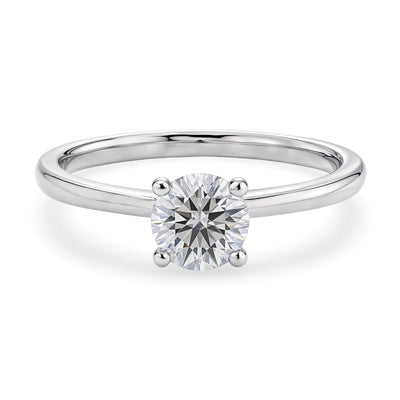
1ct Round Lab Grown Diamond Ring | 14K Gold
$2,011.00
View the piece
Why Guessing From the Average Is Risky
A ring that is one size too small will not pass the knuckle. A ring that is one size too large spins on the finger, lets the diamond turn toward the palm, and can slip off in cold weather when fingers shrink. Neither is a disaster, because a ring can be resized, but both take the shine off the first days of an engagement.
Fingers also change through the day. They are larger in the evening, in warm weather and after exercise, and smaller first thing in the morning and in the cold. A size taken at the wrong moment can be off by half a size, which is why a ring she already wears comfortably is a better guide than any single measurement.
How to Find Her Ring Size Without Asking
These methods are listed from the most reliable to the least. Use the first one you can manage without giving the plan away.
Borrow a ring she wears on her ring finger
This is the best method by a wide margin. Choose a ring she wears on the ring finger of her left hand, or failing that the same finger on her right hand. Take it to a jeweler to be measured on a ring mandrel, or measure the inside diameter yourself and match it against the size chart. If you cannot take the ring out of the house, press it into a bar of soap or trace the inside edge on paper with a sharp pencil, then measure the tracing. A ring from a different finger is only a rough guide; index and middle fingers are usually larger.
Ask someone close to her
A sister, a parent or a close friend may already know her size, or can find out without raising suspicion, for example by suggesting they try on rings together. Choose someone who can keep the secret, and ask them to check a ring she wears rather than relying on what she says, since many people do not know their own size.
Use a ring she leaves out
Many people take a ring off at night or before washing up. If she leaves one on a dresser or by the sink, that is your chance to trace or measure it and put it back in the same place.
Compare against your own finger
Slide one of her rings onto your own little finger and mark how far down it stops. A jeweler can then estimate the size from where it sat. It is an estimate, not a measurement, so use it only when nothing better is available.
Avoid the string method
Wrapping a string or a strip of paper around her finger while she sleeps is the method most often suggested and the one most often wrong. String stretches, it is hard to keep level, and it measures the base of the finger rather than the knuckle the ring has to pass over.

If You Are Between Sizes or Unsure
Choose the larger size. A ring that is slightly loose can be worn safely until it is resized, while a ring that is too small cannot be worn at all. If your best estimate falls between two whole sizes, order the half size between them.
Choose a solitaire for a surprise. A solitaire has a plain band that can be sized up or down without disturbing the diamond. Full eternity bands, with diamonds set all the way around, are made to size and cannot be resized, so they are a better choice once you know her size for certain. A classic 1 carat round solitaire or a 1 carat oval solitaire is a safe place to start, and a 2 carat cushion solitaire suits someone who prefers a softer, squarer outline.

Our solitaires are offered in sizes 3 to 9, including half sizes, in 14K white or yellow gold. Browse the full range of lab-grown diamond engagement rings and choose the size you are most confident in.
One resize is included with every ring, so an honest guess is not a costly one. Resizing takes 1 to 3 weeks once the ring reaches us; you send it to us by UPS at your cost, and we pay to ship it back. Additional resizes after the first are chargeable.
After the Proposal: Getting the Fit Right
Once she has said yes, the size no longer needs to be a secret. Have her finger measured by a jeweler, ideally late in the day when fingers are at their largest, and compare that with how the ring feels. A well-fitting ring slides over the knuckle with a little resistance and does not spin once it is on.
If you are still deciding whether to propose with the ring or choose it together, our guide to proposal rings versus engagement rings covers both approaches. For everything else that goes into choosing the ring, from the diamond to the setting, see the sizing section of our complete guide to choosing an engagement ring.


0 comments