

To clean diamond earrings, soak them for a few minutes in warm water with a few drops of mild dish soap, brush gently behind and around each stone with a soft toothbrush, rinse under warm running water and let them dry fully before wearing. That routine, done every few weeks, removes the film of lotion, soap and skin oil that dulls a diamond. The stone itself is the hardest natural material known, so what needs care is that film and the gold parts that hold the stone. This guide covers what to use, what to avoid and how to keep posts and backs clean on lab-grown diamond stud earrings.
How to Clean Diamond Earrings at Home
A diamond earns its sparkle from light entering through the top and returning from the facets underneath. Anything coating the underside, even a thin layer of hand cream or hair product, cuts that light return, and the stone reads flat and gray. A stud sits under hair and against skin all day, so the back of the stone collects film faster than most jewelry.
- Prepare a bowl. Fill a small bowl with warm water, not hot, and add a few drops of mild, unscented dish soap.
- Soak. Remove the backs and place the earrings and backs in the water for three to five minutes to soften the film.
- Brush. Use a soft, clean toothbrush kept only for jewelry. Brush the underside of each stone, between the prongs, along the post and inside the back.
- Rinse. Rinse under warm running water with the sink drain closed or a strainer in place, so nothing small can slip away.
- Dry. Pat dry with a lint-free cloth and let the pair air-dry fully before the backs go on.
Every few weeks suits a pair worn most days. A pair kept for occasions needs a clean only when it starts to look dull. Handle the earrings by the post and the back rather than the stone, since fingers leave the same oil the clean just removed.
 Mentioned in this piece
1 Carat Lab Grown Diamond Stud Earrings in 14K Gold
$794.00
View the piece
What to Clean Real Diamond Earrings With
Warm water, a few drops of mild dish soap and a soft brush are all real diamond earrings need. The diamond tolerates almost any household cleaner; the gold, the prongs and the post are where the wrong product does harm, and each of the common shortcuts has a better alternative.
Is it better to clean earrings with rubbing alcohol or peroxide?
For cleaning the diamond, neither. Soap and water lift the oily film that dulls a stone; alcohol and peroxide are disinfectants, not degreasers. For disinfecting the post, a wipe with isopropyl rubbing alcohol on a cotton pad is the simpler choice: it evaporates quickly and leaves no residue. Hydrogen peroxide also disinfects, but there is no need to soak gold earrings in it. Rinse and dry the post afterward either way.
Can you use Windex to clean diamond jewelry?
Glass cleaner can cut the film on a loose diamond, but it is made for windows, not for gold. Its ammonia and added dyes and fragrance are best kept away from the metal and the setting, and the soap-and-water routine removes the same film without them.
Can you use toothpaste to clean diamonds?
No. Toothpaste is abrasive by design. It cannot scratch the diamond, but it leaves fine scratches across polished gold and dulls the finish of the prongs and the post. Use the soft toothbrush with soap and water, never with toothpaste.
Vinegar and baking soda
White vinegar and baking soda appear in many home jewelry cleaner recipes. Neither is needed for diamond earrings. Vinegar is an acid, and there is no reason to soak a gold alloy in acid when soap does the job; baking soda is a mild abrasive with the same drawback as toothpaste on a polished surface. Keep chlorine bleach and pool chlorine away from gold altogether.

How to Clean Diamond Stud Earrings: Posts and Backs
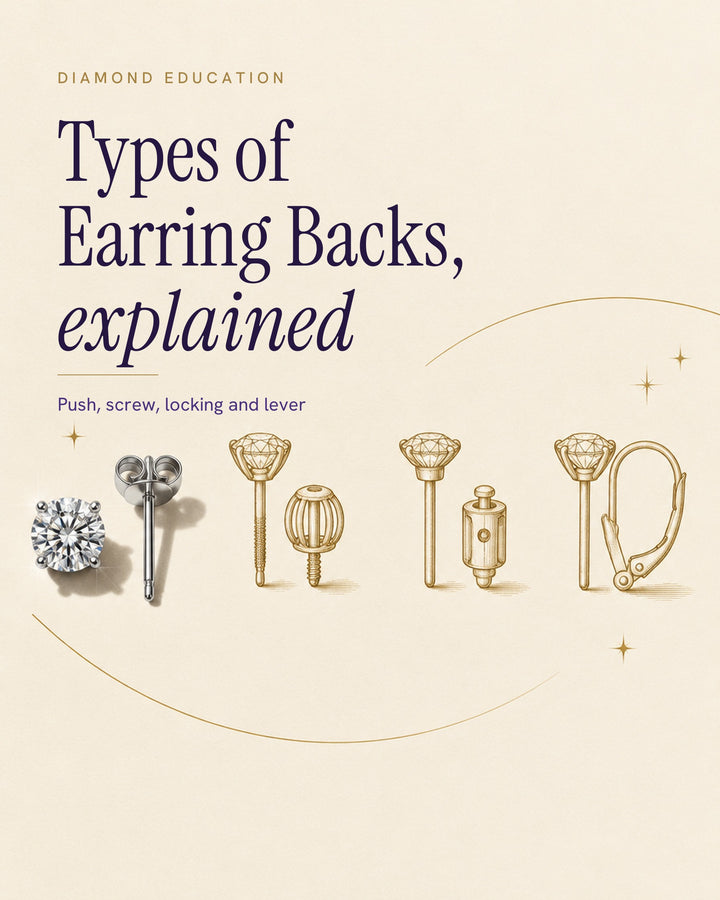
On a stud, the parts that touch skin collect more residue than the stone does. The post passes through the piercing and the back sits behind the lobe, so both gather skin oil and dead skin cells. Soak the backs with the earrings, brush the inside of each back where it grips the post, and brush the post along its full length. The guide to types of earring backs covers how each kind of back holds and when one needs replacing.
Every DEEVE lab-grown diamond stud, from the 1 carat pair to the 2 carat, 3 carat and 4 carat pairs, sits in a four-prong basket in solid 14K white or yellow gold and closes with a push back, as each pair's specification table records. A push back holds by friction, so while the pair is clean and in your hand, check the grip: the back should take deliberate effort to slide off the post. A back that slides on too easily is due for replacement before the pair is worn again.
How to Disinfect Earrings and Stop Them Smelling
When earrings smell, the cause is a build-up of skin oil, dead skin cells and bacteria on the post and inside the back, not the diamond or the gold. The soap-and-brush clean removes most of it. To disinfect afterward, wipe the post with isopropyl rubbing alcohol on a cotton pad and let it dry.
To disinfect earrings without alcohol, wash the post and back in warm soapy water, rinse well and dry completely; for most people, a clean, dry post is all a healed piercing needs. Cleaning the back of the earlobe in the shower while the earrings are out helps as much as cleaning the jewelry. A new piercing follows the piercer's aftercare instructions instead.
Can You Shower or Sleep in Diamond Earrings?
A diamond stud will not be harmed by a single shower, but it is better taken out. Soap and shampoo leave a film under the stone, which is the dullness a clean is meant to remove, and conditioner and hair product add to it. Take studs out for the pool and the hot tub as well, since chlorine is hard on gold alloys.
Sleeping in diamond stud earrings is common, and it is better avoided. A pillow presses on the back all night, which bends posts over time and loosens the grip of a push back, and the back can work its way off without anyone noticing. Taking the pair out at night also gives the piercing air and gives you a moment to see the stones are still secure.

Ultrasonic and Professional Cleaning
Ultrasonic cleaners use vibration in a liquid bath to shake film loose from hard-to-reach places. Diamond itself handles ultrasonic cleaning well, and a lab-grown diamond is the same material as a mined one. The risk is to the setting: the vibration can work loose a stone held by a worn or lifted prong. If a pair has not been inspected for a while, have the prongs checked before it goes into an ultrasonic bath.
How studs are set, sized and cared for is covered in full in the care section of our diamond stud earrings buying guide. To choose a pair, compare every carat weight in the diamond stud collection, or start with the 1 carat pair for everyday wear.
Once a year, have the pair looked at by a jeweler who can tighten prongs, check that each stone is secure and restore the polish on the gold. On a DEEVE pair, that bench work is complimentary for the life of the piece: cleaning, inspection and prong tightening, with the lifetime warranty covering the original purchaser.




0 comments