
Radiant vs cushion cut vs princess is a choice between three square-ish brilliant cuts that look alike in a line drawing and quite different on a hand. All three are cut with triangular and kite-shaped facets, so all three sparkle the way a round brilliant does; what separates them is the outline. A cushion cut has rounded corners and a soft, pillow-like edge. A radiant cut keeps straight sides and clips its four corners. A princess cut is a true square with sharp, uncut corners. At the same carat weight and grade, the decision comes down to the outline you want to see every day, how the corners are protected, and how the stone sits beside a wedding band. This guide compares the three across light, grade, size, style, setting and daily wear, using the cushion, radiant and princess solitaires in our lab-grown diamond engagement rings as the reference.
Radiant vs Cushion Cut vs Princess: The Three Outlines
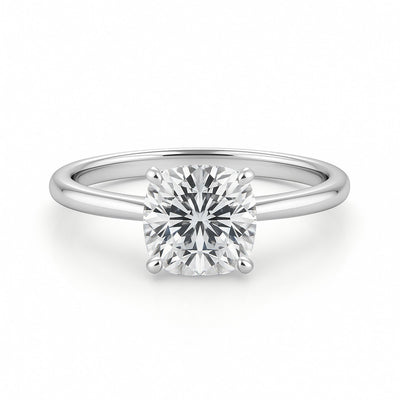
Start with the outline, because it is the one difference you can see from across a table. The cushion cut is the oldest of the three. It descends from the old mine cut of the eighteenth and nineteenth centuries, which is why it reads as soft and a little antique: a square or slightly rectangular stone with rounded corners and gently curved sides, so the whole outline looks like a pillow. The 2 carat cushion solitaire is the reference stone for this guide.
The radiant cut was developed in the 1970s to put brilliant faceting inside the rectangular outline of an emerald cut. Its sides are straight and its four corners are cut off at an angle, so the outline is an octagon with four long sides and four short ones. The 2 carat radiant solitaire is cut to the same grade as the cushion, so the two can be compared on shape alone.
The princess cut is the youngest and the most geometric: a square brilliant with four sharp corners and straight sides, seen from above as a true square. It carries the most contemporary look of the three, and its corners are the one thing a setter must plan for. The 2 carat princess solitaire completes the trio.

 Mentioned in this piece
2ct Cushion Lab Grown Diamond Solitaire Engagement Ring | 14K Gold
$2,513.00
View the piece
How Each Shape Handles Light
Because all three are brilliant cuts, all three return light in many small flashes rather than the broad planes of a step cut such as the emerald. The differences are in the pattern. A princess cut's pavilion facets run in chevrons toward the corners, so under a lamp it shows a crisp field of small sparkles with a bright cross through the center, and the corners light up as the hand turns. It is the sharpest-looking light of the three.
A cushion cut's rounded outline gives it larger facets and a softer light return, often with a few broader flashes mixed in among the small ones. Some cushions are cut in a chunky, antique style with a facet pattern you can read with the naked eye; others, often called crushed-ice cushions, are cut with many tiny facets that glitter without a readable pattern. Both are correct cuts; they are two different looks, and it is worth knowing which one you are looking at before you compare it with a radiant.
A radiant cut sits between the two: straight sides like a princess, trimmed corners like an emerald, and a faceting style that usually reads as dense and lively, closer to crushed ice than to a chunky cushion. In low light a radiant and a crushed-ice cushion keep picking up whatever light there is; a chunky cushion and a princess show fewer, larger flashes. None of this is better or worse. It is the difference between a stone that glitters and a stone that flashes, and most people know which they prefer within a minute of seeing the three together.
Color and Clarity: What Each Cut Shows
All three shapes are forgiving of small inclusions, because brilliant faceting breaks up the light paths and hides a pinpoint far better than the open window of a step cut does. Where they differ is color. A brilliant cut with an elongated outline or with deep corners can gather a little body tint at its ends or in its points, so a princess cut can show a touch more color at the corners, and a long radiant at its ends, than a round of the same grade. A cushion, with its rounded outline, tends to hold color evenly across the stone. At G (near-colorless) in a white gold setting none of this is visible to the eye; it matters only if you are shopping lower on the color scale.
Holding the grade constant is what makes the comparison honest. The cushion, radiant and princess solitaires in this guide are all G (near-colorless), VS1 (very slightly included), with Excellent polish and Excellent symmetry, grown by the CVD process and graded by IGI. Put the three 2 carat rings side by side and the only variable left is the cut. A VS1 grade is more than these shapes strictly need in order to look clean, which is the point: there is nothing to find, in any of the three.
Size on the Hand: Outline, Ratio and Corners
Carat is weight, not size. What you see on the hand is the face-up area, and that depends on how the cutter divides the weight between spread and depth. A princess cut is usually cut deep to feed its brilliance, so it tends to present the smallest face for its weight of the three. A cushion sits in the middle, and a radiant, especially an elongated one, often presents the largest face. These are tendencies rather than rules; a cutter's choices can reverse them, and our product records carry each stone's weight rather than its millimeter measurements, so the reliable way to judge size is to compare the three rings at the same weight rather than to trust a figure.
The ratio matters as much as the shape. A princess cut is square. A cushion and a radiant can each be cut square or elongated; as a rule of thumb, a square cushion or radiant sits near 1 to 1 and an elongated one between about 1.2 and 1.5 to 1. An elongated cushion and a radiant are the two stones most often confused on the hand: both long, both brilliant, both bright. The tell is the corner, rounded on the cushion and clipped straight on the radiant. An elongated stone lengthens the finger and looks larger for its weight; a square stone sits lower and reads as a block of light.
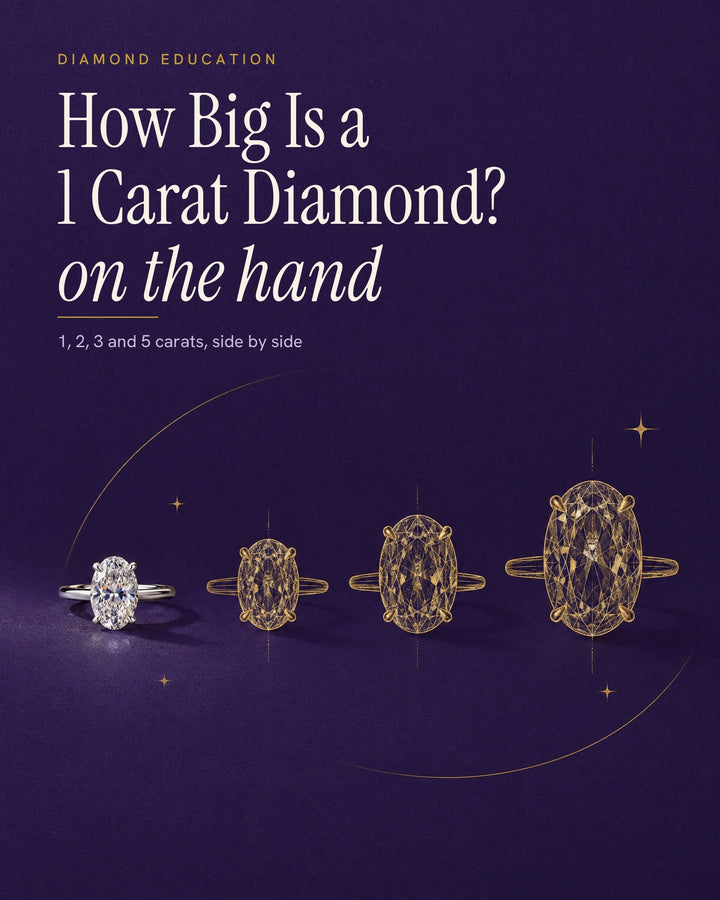
If you want more presence on the hand, the 3 carat cushion solitaire, the 3 carat radiant and the 3 carat princess step all three shapes up together, and the 1 carat and 1.5 carat sizes step them down. Our guide to how big a 1, 2, 3 and 5 carat ring looks on the hand covers scale in more detail.


Which Style Suits Which Person
The cushion cut belongs to soft lines. It suits someone who wears vintage or romantic pieces, rounded forms, yellow gold, and jewelry with a little history to it. It reads warm and timeless rather than sharp, and it is the shape most often chosen for a halo or an antique-style setting, though it is just as at home as a plain solitaire. If the jewelry she already wears is rounded and warm, the cushion is usually the answer.
The radiant cut belongs to someone who wants a long, bright stone with a clean geometric edge. It suits a hand that wears pavé bands and pieces chosen for how they catch light, and it photographs with more fire than either of the others. If she stops in front of windows to watch a ring flash, the radiant is usually the answer.
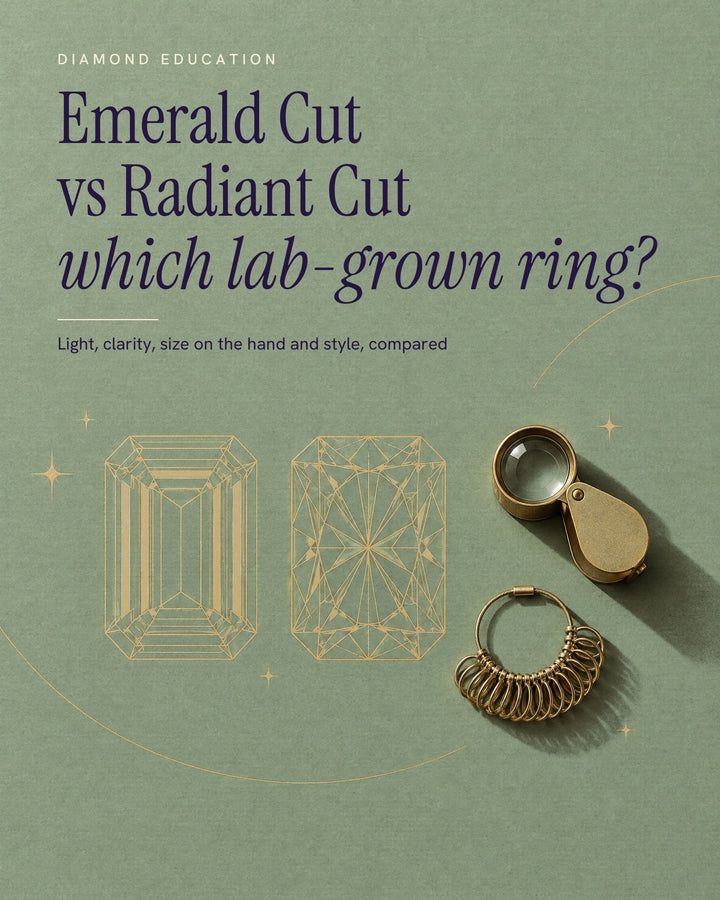
The princess cut belongs to clean, modern lines. It suits someone who wears minimal, architectural jewelry, straight bands, white metal and square forms, and who would rather a ring be crisp than soft. It is the most contemporary of the three and the one that pairs most naturally with a plain, flat wedding band. For the other shapes we offer, round, oval and emerald, see choosing the diamond shape in our guide to choosing an engagement ring; for the two rectangular cuts side by side, see our emerald cut vs radiant cut comparison.
Setting, Durability and Daily Wear
Diamond is the hardest natural material, but hardness is resistance to scratching, not to a knock, and a sharp point is where a diamond is most likely to chip. That is the practical difference between these three shapes. A princess cut has four exposed points, so its prongs sit over those corners where the stone most needs cover; a chipped corner on a princess is the classic repair a setter sees. A radiant has its corners clipped off, so there is no point to protect. A cushion has rounded corners and is the most forgiving of the three.

All three solitaires are set the same way: a four-prong head on a 1.50 mm band of solid 14K white gold, or 14K yellow gold with a 14K white gold head if you prefer a warm band under a bright stone. On the princess the four prongs are placed on the corners, which both protects them and keeps the square outline clean. The white gold is rhodium finished, and a prong check once a year catches a lifted prong long before a stone is at risk, which matters most on the princess.
On the wedding band, all three shapes have straight or nearly straight sides, so a straight band sits flush against the shank with no need for a curved or contoured band. A thin band balances an elongated cushion or radiant; a flat, slightly wider band holds its own beside a square princess. Cleaning is the same for all three: warm water, a drop of dish soap and a soft brush, then dry the ring fully before it goes back in the box. A ring should come off for the gym, the garden and anything that loads the hand, and that goes double for a princess.
Expert Breakdown: Choosing Between Them at DEEVE
If you are still torn, three questions settle it. What does she already wear: soft, rounded, vintage pieces, which point to the cushion; long, bright, light-catching pieces, which point to the radiant; or crisp, minimal, geometric pieces, which point to the princess? How much does corner protection matter to her life: a princess asks for a little more care and an annual prong check, while a radiant and a cushion ask for less. And how will the ring sit beside a band: a princess beside a flat band, an elongated cushion or radiant beside a thin one.
Whichever you choose, the stone is the same in every way but its outline. Our cushion, radiant and princess solitaires are offered at 1 carat, 1.5 carat, 2 carat, 3 carat and 5 carat, all G (near-colorless) and VS1 (very slightly included), all with Excellent polish and symmetry, in sizes 3 to 9; the 2 carat cushion solitaire, for one, arrives with its IGI certificate in the box. A lab-grown diamond is a real diamond, the same chemically and structurally as a mined one, grown in a laboratory rather than taken from the ground, and it costs approximately 70 percent less than a natural diamond of the same size and grade. That is what makes a 3 carat cushion, radiant or princess a realistic choice rather than a fantasy.
When you are ready, compare the 2 carat cushion, the 2 carat radiant and the 2 carat princess side by side in our lab-grown diamond engagement rings, or go straight to the 3 carat trio. Delivery is free worldwide and takes 5–7 business days. One resize is included with every ring and takes 1 to 3 weeks once the ring reaches us; you send it in by UPS at your own cost and we ship it back at ours. Additional resizes after the first are chargeable, and a catalogue ring can be returned within 30 days if the shape turned out to be the wrong one.
Warranty. Every DEEVE ring carries a lifetime warranty for the original purchaser, covering cleaning, polishing, prong retipping, rhodium re-plating and stone resetting, with complimentary cleaning, inspection and prong tightening for the life of the ring. Read the warranty.

0 comments