
How long does it take to resize a ring? At the bench, a straightforward resize of a plain or solitaire band is a few hours of work; what fills the calendar is the queue ahead of it, the metal and finish involved, and the shipping on either side. A local jeweler with a bench on site often turns a simple resize around in a few days to two weeks. At DEEVE, a resize typically takes one to three weeks from the day the ring reaches our workshop, and one resize is included with every ring. This guide explains what happens to the ring in that time, how far a ring can be moved up or down, which rings cannot be resized at all, and how to send a ring from our lab-grown diamond engagement rings back to us when the size needs to change.
How Long Does It Take to Resize a Ring? The Timeline, Piece by Piece
There are two clocks. The first is bench time: the hours a goldsmith spends cutting, soldering, shaping and polishing. For a plain band or a solitaire with a clear shank, that is a short job. The second clock is everything around the bench: the rings already waiting, a stone that has to come out and go back, a white gold finish that needs renewing afterward, and the days the ring spends in transit if it is being sent rather than carried in. The second clock is what turns a few hours of work into a few weeks of waiting.
As a rule, the simpler the ring, the shorter the wait. A solitaire on a plain shank is the easiest ring there is to resize, because the stone sits at the top in its own head and the work happens at the bottom of the band, away from it. Rings with stones set along the shank take longer, because each stone near the cut has to be checked and sometimes reset. Platinum and heavily patterned bands take longer still. Engagement ring resizing also has a season: the weeks after the holidays, when rings given at Christmas and New Year come back for fitting, are the busiest of the year for most benches, and a resize booked then can take longer than one booked in the spring.
The DEEVE figure is one to three weeks from the day the ring reaches us, not from the day it leaves you. Add the UPS transit in each direction to find the time the ring is actually away from the hand. The simplest way to shorten the whole process is to get the size right before the ring is bought, which the last section of this guide covers, and the second simplest is to send the ring in as soon as the size is known rather than waiting for a convenient week.
 Mentioned in this piece
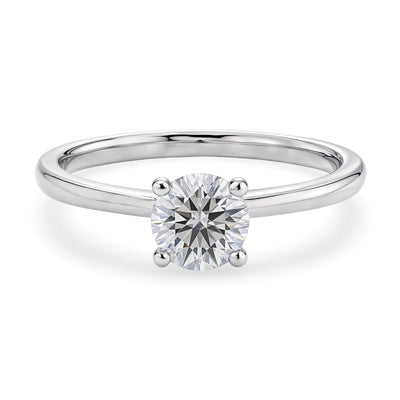
1ct Round Lab Grown Diamond Solitaire Engagement Ring | 14K Gold
$2,011.00
View the piece
What Happens at the Bench: How a Ring Is Resized
To make a ring smaller, the goldsmith cuts a short section out of the bottom of the shank, closes the gap, solders the join, then rounds the band on a steel mandrel and polishes the seam until it disappears. Done well, the join is invisible, and the band is as strong at the seam as it is anywhere else. To make a ring larger, the goldsmith cuts the shank once, opens it, and solders in a piece of matching gold of the right length; for a very small increase on a plain band, the ring can sometimes be stretched on the mandrel instead, without adding metal.

A solitaire like the 1 carat oval solitaire is the textbook case. Its four prongs hold the stone in a head above the band, and the band itself is a plain 1.50 mm shank of solid 14K gold, so the cut is made well away from the setting and the diamond never has to come out. After the join is polished, the prongs are checked and tightened, the ring is cleaned, and if it is white gold the rhodium finish is renewed so the resized band matches the rest of the ring. That finishing step is part of why a white gold resize takes a little longer than a yellow gold one.

A lab-grown diamond changes none of this. It is the same diamond chemically and structurally as a mined one, and it sits in the same four-prong head; the goldsmith works on the gold, not the stone. The only time the stone is involved at all is in the prong check at the end, which is good practice on any ring that has been heated at the bench.
How Many Sizes Can a Ring Be Resized?
As a rule of thumb, most rings can be taken up or down by about two sizes without changing their proportions. Beyond that, the band either loses so much metal that it looks thin against the head, or gains so much that the ring sits differently on the finger. The honest answer for any one ring is given at the bench, once the goldsmith has it in hand, because the band's width and thickness and the setting decide how far it can go.
Half sizes matter more than most people expect. A ring that is half a size large spins; a ring that is half a size small will not pass the knuckle on a warm day. Our solitaires, from the 2 carat round solitaire down to the 1 carat pieces, are offered in sizes 3 to 9 in half-size steps, so the right size is usually on the shelf, and a resize is a half size or a whole size rather than a leap. If a ring turns out to be several sizes away from the right one, a return within the 30-day window and a fresh order in the right size is often the cleaner path than a large resize, and a catalogue ring can be returned within 30 days for exactly that reason.
Which Rings Cannot Be Resized
Some rings are made in a way that leaves no plain shank to cut. A full eternity band, with diamonds set the whole way round, is the clearest case: there is nowhere to make the join without disturbing a stone, so a full eternity band is made to size and never resized. Tension settings, which hold the stone by the spring of the band itself, lose their grip if the band is altered. Bands set with stones most of the way round, or engraved or patterned along their full length, can sometimes be resized by a small amount, but the pattern will show the join.
Metal matters too. Gold, platinum and silver all solder cleanly, which is why a solid 14K gold ring is the easiest kind to resize. Tungsten, titanium and ceramic rings cannot be cut and rejoined at the bench, and a ring in one of those metals is usually exchanged for another size rather than resized. If a ring is likely to need adjusting later, choosing a plain-shank solitaire in gold, like the 1.5 carat cushion solitaire, keeps every option open.
Engagement Ring Resizing at DEEVE: What Is Included and How It Works
Every solitaire in our lab-grown diamond engagement rings is offered in sizes 3 to 9, so the right size is usually on the shelf; what follows is what happens when it is not, and it applies to every ring in the collection.
One resize is included with every DEEVE ring, with no time window attached to it: whether the size is wrong on the day of the proposal or a hand changes a year later, the first resize is on us. Additional resizes after the first are chargeable. Resizing is a service we offer alongside the lifetime warranty rather than a line within it; the warranty covers cleaning, polishing, prong retipping, rhodium re-plating and stone resetting for the life of the ring, and the one included resize sits beside that.

To send a ring in, write to support@deeve.ca with your order number and the size you need, and we will confirm the details. You ship the ring to us by UPS at your own cost; warranty and resize pieces are received by UPS only, never in person. Once it reaches our workshop, the resize typically takes one to three weeks, and the ring is cleaned, its prongs checked and its finish renewed before it goes back. We ship it back to you at our cost. Keep the box and the certificate at home; only the ring travels. The 1 carat round solitaire, for instance, arrives with its IGI certificate in the box, and the certificate belongs to the stone, which the resize never touches.
Resizing is also the one change DEEVE makes to a ring after the proposal. Rings are not redesigned, and a catalogue ring that is the wrong ring rather than the wrong size can be returned within 30 days. Between those two, the size question is never a reason to delay the proposal itself: propose with the ring you have, and fit it afterward.
Getting the Size Right So the Ring Never Needs a Resize
The best resize is the one that never happens. Fingers change size through the day and the year: they are slimmer in the morning and in cold weather, fuller in the evening and in summer, so a size measured at the end of a warm day is the safer one to order. A ring should slide over the knuckle with a little resistance and sit at the base of the finger without spinning. If the knuckle is noticeably larger than the base of the finger, choose the size that passes the knuckle and accept a little movement below it.
When you are ready, compare the 1 carat oval and the 1 carat round in our lab-grown diamond engagement rings, each offered in sizes 3 to 9. Delivery is free worldwide and takes 5–7 business days, and if the size needs to change afterward, one resize is included.
For a surprise proposal, our guide to finding her ring size without asking walks through the ways to measure a ring she already wears. If the size is still uncertain, order the size you believe is right rather than waiting: the included resize is there for the half size either way, and the ring is on the hand for the proposal rather than in a queue. Our guide to choosing an engagement ring covers warranty, resizing and care in its final step, if you want the whole after-sale picture in one place.
Warranty. Every DEEVE ring carries a lifetime warranty for the original purchaser, covering cleaning, polishing, prong retipping, rhodium re-plating and stone resetting, with complimentary cleaning, inspection and prong tightening for the life of the ring. Read the warranty.

0 comments