

A lab grown vs natural diamond tennis bracelet comparison ends in an unusual place: the two are the same material, and the reasons to choose one over the other have almost nothing to do with the stones themselves. Lab-grown and mined diamonds share the same chemistry, the same crystal structure, the same hardness and the same optics, and nothing visible under a loupe separates them. What differs is origin, price and resale, and on a tennis bracelet specifically one more thing, matching, which is the whole job on a strand of thirty to a hundred stones. This guide sets the two side by side, explains why the design tilts the decision toward lab-grown more than a solitaire does, covers the price and resale arithmetic honestly, and answers the questions buyers ask.
Shop lab-grown diamond tennis bracelets
What Makes a Diamond a Diamond
A diamond is defined by its crystal structure: carbon atoms arranged in a cubic lattice. That structure gives diamond its hardness, 10 on the Mohs scale and the hardest natural material, its refractive index of 2.42, which is responsible for brilliance and fire, and its thermal conductivity. Lab-grown and natural diamonds share that structure identically. They are the same material, graded on the same scales by the same laboratories, and they wear, chip and polish the same way.
What differs is how the structure formed. A natural diamond crystallized under extreme heat and pressure deep in the earth over an immense span of time. A lab-grown diamond is produced in weeks by chemical vapor deposition, CVD, in which carbon is deposited layer by layer onto a seed crystal in a controlled chamber, replicating the same crystallization under controlled conditions. The result is a diamond, not a simulant: cubic zirconia and moissanite are different materials with different optics, and a jeweler separates them from diamond in seconds. Separating a lab-grown diamond from a mined one takes spectroscopic instruments that read growth features, because there is nothing optical to read.
 Mentioned in this piece
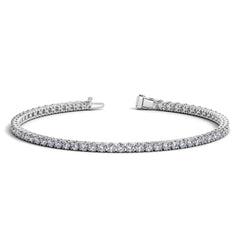
3 Carat Lab Grown Diamond Tennis Bracelet in 14K White or Yellow Gold
$2,409.00
View the piece
Mentioned in this piece
3 Carat Lab Grown Diamond Tennis Bracelet in 14K White or Yellow Gold
$2,409.00
View the piece
Lab Grown vs Natural Diamond Tennis Bracelet: Side by Side
| Property | Lab-grown diamond | Natural diamond |
|---|---|---|
| Chemical composition | Carbon | Carbon |
| Crystal structure | Cubic | Cubic |
| Hardness (Mohs) | 10 | 10 |
| Refractive index | 2.42 | 2.42 |
| Graded on the same scales | Yes | Yes |
| Consistency across a strand | High: grown to a specification, so stones match closely | Variable: matching depends on parcel selection |
| Origin | Grown in a chamber over weeks | Mined |
| Price at equal grade | A fraction of natural, and the gap widens with size | Benchmark |
| Resale value | Lower | Higher, though far below retail |
| Telling them apart | Not by eye or loupe; spectroscopic equipment only | |
Why Lab-Grown Has an Advantage in a Tennis Bracelet
A tennis bracelet is a multi-stone piece: anywhere from 30 to more than 100 diamonds, depending on the carat weight and the stone size. For the strand to look right, every one of those stones has to match its neighbors in color, clarity and cut, because the design is repetition and the eye reads each stone against the one beside it. A single stone a grade warmer, or cut a little shallower, interrupts the line, and the interruption is visible from across a table.
With natural diamonds, that consistency has to be found. A cutter sorts through parcels of stones that vary in every property, selects the ones that match, and either accepts small compromises or pays a premium for a tightly matched run. With lab-grown diamonds the consistency is built in: stones grown under the same conditions to the same specification come out uniform in color and clarity, and a matched strand is the normal result rather than a selection exercise. On a solitaire the origin argument is worth having; on a strand of sixty stones, matching is the whole job, and grown diamonds match better for less money.
That is why DEEVE's tennis bracelets are set with lab-grown diamonds only, at E–F (colorless) color and VVS2–VS1 (very, very slightly to very slightly included) clarity, certified by AGI, cut to Excellent and matched across the strand at every weight from 2 to 10 carats. The grade is held constant so that the only decision left to the buyer is the total.
The Price Difference
At equal grade and equal weight, a lab-grown tennis bracelet costs a fraction of a natural one, and the gap widens as the weight rises, because large natural stones are rare and large lab-grown stones are not. Lab-grown costs approximately 70% less than natural at the same size and grade. In practice the difference is what puts the heavier weights within reach: a 6, 8 or 10 carat natural tennis bracelet is a showcase piece, and the same strand in lab-grown diamonds is a purchase an ordinary buyer can make. Because the price of a strand is driven first by total carat weight, second by origin, third by the gold and fourth by the setting labor, the origin decision is the single largest lever a buyer holds after choosing the weight. The cost section of the buying guide takes the four drivers in order.
The Resale Consideration
Natural diamonds hold more resale value than lab-grown, and that is the honest case for them. It should be stated with its limits. Diamond jewelry of either origin resells well below its retail price, because retail includes the setting, the labor and the margin and resale pays for the stones and the metal; a buyer who intends to sell a bracelet later will lose money on either. The natural strand loses less as a proportion, the lab-grown strand loses less in absolute terms because it cost less to begin with, and the gold in both is worth its weight regardless. A tennis bracelet bought to be worn for decades is not an investment in either case, and the question to ask is which strand will be worn.
Ethics and Origin
A lab-grown diamond is grown in a chamber, so it involves no mining and its origin is known. That matters to many buyers and it is a fair reason to choose one. It is not a reason to distrust natural stones as a class, and the point of this comparison is that the material is the same either way; a buyer who wants a mined stone for its own sake is choosing a story, not a better diamond. What can be said plainly of DEEVE's strands is where the stones come from, which is a controlled chamber, and how they were graded, which is to a stated standard across the whole strand.
How to Tell Them Apart
By eye, a jeweler cannot, and neither can a loupe. At the stone sizes used in a tennis bracelet there is no visible feature that reliably separates a grown diamond from a mined one, because the two have the same optics. Identification is done with spectroscopic equipment that reads the way the crystal grew, and a grading laboratory records the origin on that basis. What a buyer can see, and what actually decides how a bracelet looks, is the consistency of color and cut across the strand, which is where lab-grown stones have the advantage described above. The definition of a tennis bracelet covers what to look for in the strand itself.
The Verdict
For a solitaire, the choice between lab-grown and natural is a matter of preference and budget, and both answers are reasonable. For a tennis bracelet the design itself tips the balance: matching is the whole job, lab-grown stones match better, and the saving is largest at exactly the weights where the bracelet becomes impressive. The 3 carat lab-grown diamond tennis bracelet shows the case at the entry weight, a refined line of matched stones in solid 14K gold, and every strand in the lab-grown diamond tennis bracelet collection is built to the same grade. The rest of the decision, from carat weight to metal to clasp, is in the lab-grown versus natural section of the complete buying guide.



0 comments