

Knowing how to size a tennis bracelet is a matter of one measurement and one allowance. Measure the wrist where the bracelet will sit, add room for the strand to move, and buy or fit the length that matches; nothing about carat weight or width changes that number. A tennis bracelet has a fixed length and a clasp, so unlike a slider or an adjustable chain it has to be right, and the good news is that it can be corrected: the joints between the mounts can be opened and rejoined, so a strand that arrives long or short is shortened or lengthened by a jeweler rather than returned. This guide covers how to measure, how much to add, how to read a size chart, what a standard length is, when to size up or down, and what to do when the wrist is not yours.
How to Measure Your Wrist
1. Find the spot. A tennis bracelet sits just above the wrist bone, on the narrow part of the forearm where it can rotate without sliding over the hand. Measure there, not at the widest point of the wrist bone itself.
2. Wrap. Use a soft tape measure, or a strip of paper or string that you mark and then lay against a ruler. Wrap it snug against the skin but not tight; it should touch all the way round without compressing anything.
3. Read. Note the measurement in centimeters or inches. Take it twice at different times of day, because wrists swell slightly in heat and after exercise, and use the larger figure.
4. Add the allowance. Add roughly 1.5 to 2 cm, a little over half an inch, to the wrist measurement. That is the room the strand needs to rotate freely and to drape rather than grip. Less than that and the bracelet sits rigid and pulls at a sleeve; more than that and it slides over the hand and twists so the stones face down.
The result is the bracelet length. A 15 cm wrist, for instance, wants a strand of about 16.5 to 17 cm; a 16.5 cm wrist wants about 18 cm, which is a 7-inch bracelet.
 Mentioned in this piece
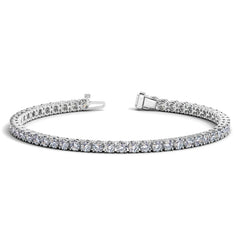
6 Carat Lab Grown Diamond Tennis Bracelet in 14K White or Yellow Gold
$3,441.00
View the piece
Tennis Bracelet Size Chart
| Wrist measurement | Bracelet length | Fit |
|---|---|---|
| Up to 14 cm (5.5 in) | 15 to 16 cm (6 to 6.25 in) | Fitted to order |
| 14 to 15 cm (5.5 to 6 in) | 16 to 16.5 cm (6.25 to 6.5 in) | Fitted to order |
| 15 to 16.5 cm (6 to 6.5 in) | 17 to 18 cm (6.75 to 7 in) | Stocked 7-inch strand |
| 16.5 to 17.5 cm (6.5 to 7 in) | 18 to 19 cm (7 to 7.5 in) | Stocked 7-inch strand, or fitted |
| 17.5 to 19 cm (7 to 7.5 in) | 19.5 to 20.5 cm (7.75 to 8 in) | Fitted to order |
| Over 19 cm (7.5 in) | 21 cm and up (8.25 in and up) | Fitted to order |
Read the chart from the wrist column, not from a bracelet you already own, because different designs sit differently. When a wrist falls on a boundary, size up: a strand that is slightly loose is more comfortable and easier to clasp than one that is slightly tight, and a loose strand can always be shortened.
What Is a Standard Tennis Bracelet Length?
Seven inches, about 18 cm, is the standard length across the trade, and it suits most adult wrists between roughly 15 and 17 cm. DEEVE's strands are stocked at 7 inches in every carat weight from 2 to 10 carats. A wrist outside that range is fitted to order at the length the measurement gives, and a stocked strand that arrives a fraction long or short is adjusted rather than exchanged.
Width is a separate matter and it does not change the length. A 10 carat strand is noticeably wider than a 2 carat one, because larger stones need larger mounts, and a wider strand feels more present on the wrist; the length it needs is the same. Carat weight likewise sets the look and the weight of the piece, not the size; see the carat guide for how each weight reads on different wrists.
How Should a Tennis Bracelet Fit?
Correctly fitted, a tennis bracelet sits above the wrist bone with about one finger of space between the strand and the skin. It should rotate freely when the arm moves and settle with the stones facing up, and it should not slide over the hand when the arm hangs down. Held straight up, the strand should fall to the wrist bone and stop.
Three signs a strand is wrong: it twists so the stones face inward, which means it is too long; it leaves a mark or catches on the sleeve, which means it is too short; or the clasp always ends up on top of the wrist, which usually means it is too long as well. A strand that fits sits with the clasp on the underside, where it meets the least contact.
Sizing Up, Sizing Down and Resizing
Because a tennis bracelet is a chain of hinged mounts, its length can be changed. A jeweler shortens a strand by removing one or more mounts and rejoining the hinge, and lengthens it by adding mounts set with matching stones; the join is invisible on a well-made piece. Shortening is the simpler operation, which is another reason to size up when unsure. On a DEEVE strand one resize is included free; additional resizes are chargeable. A resize is a workshop service with its own turnaround, so a buyer who knows the wrist measurement is better served by ordering the fitted length in the first place.
Extenders and safety chains are not a substitute. An extender adds a section without stones that breaks the line the design depends on, and a safety chain hangs below the strand and catches on everything. If a strand is long, have it shortened.
Sizing a Tennis Bracelet as a Gift
When the wrist cannot be measured, the stocked 7-inch strand is the right guess for most adult women and a slightly loose fit for smaller wrists, and it can be shortened afterward. If a watch or bracelet the recipient wears can be measured, lay it flat, closed, and measure its inside length; that figure, less any slack the piece has, is the length to match. A bracelet bought at 7 inches and adjusted after the fact costs nothing in the design, because the mounts removed are simply set aside.
Choosing the Strand Once the Size Is Known
With the length settled, the remaining decisions are carat weight, metal and clasp, and they are covered in the sizing section of the complete buying guide. Every strand in the lab-grown diamond tennis bracelet collection is stocked at 7 inches in solid 14K yellow or white gold, closes with a box clasp and a hidden safety catch, and can be fitted to another length; the 6 carat lab-grown diamond tennis bracelet is the weight at which fit matters most, because a strand that substantial has to sit exactly right. Once it is on the wrist, the care guide covers keeping it there.



0 comments